

How to Set Feed Intervals on an AI Tennis Ball Machine for Different Drills
An AI tennis ball machine feed interval should give you enough time to complete the action the drill is meant to train. A technical repetition may need a deliberate pause, while a reaction drill may use a quicker rhythm. The shortest interval is not automatically the most realistic or productive.
Start with the drill purpose, then watch preparation, contact, balance and recovery. Adjust the interval only after you can see which part of the repetition needs more or less time.
What Feed Interval Actually Controls
Feed interval is the time between consecutive launches. It shapes the rhythm of a drill, but it does not work alone. Ball speed, trajectory, court position and distance all affect how much usable time the player experiences.
Interval Is Not the Same as Ball Speed
A faster ball reaches the player sooner, even when the machine keeps the same interval between launches. A shorter ball also reduces travel time because it lands closer to the player. For that reason, changing speed or placement can make a familiar interval feel very different.
When comparing AI tennis ball machine frequency settings, treat launch timing and incoming-ball difficulty as separate variables. If you change both at once, it becomes difficult to tell whether rushed contact came from the interval, the pace or the path of the ball.
Recovery Is the Most Useful Measurement
The practical question is not simply whether you can hit the next ball. Ask whether you can finish the stroke, regain balance, move toward the intended recovery position and prepare again before the next ball arrives.
If the feed begins while you are still falling away from the previous shot, the interval is probably too short for that drill. If you finish, recover and then stand still for several seconds, the interval may be longer than necessary unless the drill is intentionally slow and technical.
Match the Feed Interval to the Drill Purpose
The ranges below are practical starting examples, not fixed training standards or product limits. Use them to begin a test, then adjust for ball travel time, player level, court position and the specific movement required.
| Drill purpose | Starting interval | What to observe |
|---|---|---|
| Beginner contact and preparation | About 5鈥? seconds | Early preparation, stable contact and a complete reset |
| Controlled groundstroke repetition | About 4鈥? seconds | Consistent spacing, target control and balanced recovery |
| Two-point movement | About 3鈥? seconds | Efficient first step and return toward the recovery position |
| Short reaction or volley block | About 2鈥? seconds | Compact preparation without rushed or unsafe movement |
Technique Repetition Usually Needs More Time
When the objective is grip comfort, preparation, spacing or a balanced finish, use a generous interval. The player should be able to notice the result of one swing before beginning the next. This is especially important for beginners, who may need time to find the correct starting position again.
Keep placement predictable and use short sets. A slow rhythm is useful only when the player remains engaged; it should support observation rather than turn the drill into disconnected single shots.
Movement Drills Need Time for Recovery
A movement drill should challenge the route to the ball and the recovery after contact. Start with two manageable locations and choose an interval that allows the player to recover with purpose. Shorten it only when spacing and balance remain dependable.

Wide placement does not always require the fastest feed. If the next ball launches before the player can complete the intended recovery, the exercise may reward guessing or sprinting in one direction instead of repeatable court movement.
Reaction Drills Need Shorter Sets, Not Just Faster Feeds
Quick feeds can be useful for compact volleys, blocks and reaction work, but they increase fatigue quickly. Use a controlled location, a limited number of balls and a clear rest period. Stop the set when preparation becomes late or the player begins protecting balance rather than executing the intended stroke.
A short interval should create a focused timing demand. It should not turn every drill into conditioning or force the player to abandon technique.
Use Player Readiness Instead of Chasing Intensity
There is no single answer to how fast an AI tennis ball machine should feed. Two players can use the same ball speed and placement but need different intervals because their preparation, movement and recovery skills differ.
Lengthen the Interval When Quality Breaks Down
Add time when the player repeatedly contacts the ball late, skips the recovery step, loses balance or cannot return to a ready position. Also lengthen the interval after increasing width, depth, height or pace. The new ball may demand more movement even though the timer has not changed.
One poor repetition is not enough to diagnose the setting. Look for the same problem across several balls. If the breakdown is repeatable, give the player more time or simplify another variable.
Shorten the Interval When the Reset Is Consistently Early
Reduce the interval slightly when the player repeatedly finishes the intended recovery and waits in a stable ready position. Make a small change, then observe another short set. The next interval should preserve the drill goal while reducing unnecessary idle time.
Do not shorten it merely because the session feels easy. A drill can be technically demanding without being breathless, and a stable rhythm may be exactly what allows a new pattern to improve.
Adjust One Variable at a Time
A simple testing process makes AI ball machine settings for tennis drills easier to understand:
- Define one observable goal, such as recovering behind a marker before the next ball.
- Run a short set of about eight to ten balls at a comfortable interval.
- Keep speed, spin, height and placement unchanged.
- Adjust the interval by one small step.
- Repeat the set and compare preparation, contact and recovery.
This method turns the interval into a training variable rather than a difficulty dial. It also fits the progression used in structured ball machine drills for tennis: establish a stable pattern first, then add one meaningful challenge.
How TERO Pro Fits Interval-Based Practice
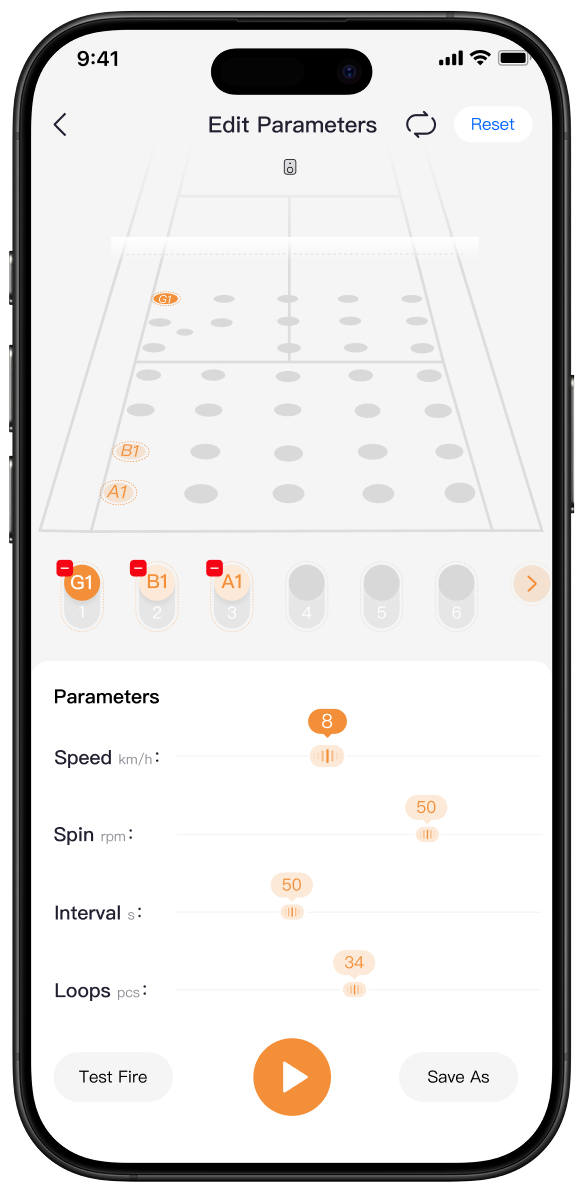
The TERO Pro AI tennis training robot supports app-customized training patterns, including an adjustable interval parameter. The app is useful for building and reviewing the drill before a set, while wristband voice control can support compatible adjustments during practice without requiring a walk back to the machine.

Programmed timing and adaptive practice serve different purposes. In a saved pattern, the interval creates a deliberate cadence between known feeds. In an adaptive rally, TERO Pro uses its 4K dual-lens vision system to analyze ball speed, trajectory and landing position, plans a return within 0.1 seconds and continues adjusting its response as the ball moves.
That difference matters because adaptive practice should not be described as a fixed sequence with a faster timer. The comparison in programmed feeds versus adaptive AI explains how predictable repetition and developing exchanges train different skills.
Common Feed-Interval Mistakes
Changing Speed and Interval Together
Increasing ball speed while shortening the interval creates two timing changes at once. If performance falls, you cannot identify the cause. Change one setting, run a short test and keep the new value only when the intended skill remains visible.
Shortening the Interval Before Recovery Is Stable
A player may reach every ball by leaning, guessing or skipping recovery. That does not mean the interval is appropriate. Require the movement pattern you want to train before reducing time.
Using Long Continuous Blocks
Rapid feeding across a full hopper can make fatigue the main challenge. Use shorter sets with planned pauses so the player can review results, reset position and maintain safe movement. Volume is useful only when the repetitions still represent the intended skill.
A Simple Three-Stage Progression
Begin with a longer interval and one predictable placement. The first target is clean preparation and balanced contact. Next, add a recovery marker and keep the same interval until the player can return consistently. Finally, shorten the interval slightly while preserving both contact and recovery.
If quality drops at the final stage, return to the previous interval rather than changing several other settings. The progression has still provided useful information: the player can perform the skill, but needs more time before it is ready for a faster rhythm.
What Feed Intervals Cannot Simulate
A machine can organize repetition and create a demanding rhythm, but the interval does not reproduce every visual cue, tactical decision or timing change produced by a live opponent. Real points include hesitation, disguise, score pressure and imperfect contact that a programmed drill may not contain.
Use interval-based practice to improve a defined movement or stroke pattern, then transfer that pattern into live hitting, coached practice and point play.
Conclusion
The right AI tennis ball machine feed interval is the one that protects the purpose of the drill. Give technical work enough time for observation, give movement work enough time for recovery, and use shorter intervals in controlled sets when reaction speed is the goal.
Begin with a reasonable starting range, change one variable at a time and judge the result through preparation, contact, balance and recovery. TERO Pro can support that process with customizable patterns, app-based interval settings, wristband voice control and adaptive rally capabilities, while the player or coach remains responsible for choosing a useful progression.
Frequently Asked Questions
Should You Change the Feed Interval When You Move Closer to the Net?
Often, yes. A ball reaches you sooner at the net because it travels a shorter distance. Begin with more time than you think you need, keep the placement controlled and shorten the interval only after compact preparation and stable positioning become repeatable.
How Many Balls Should You Hit Before Changing the Interval?
A short set of about eight to ten balls is usually enough to reveal a pattern without allowing fatigue to dominate. Base the change on repeated results rather than one excellent shot or one miss.
Should Two Players Use the Same Feed Interval for the Same Drill?
Not necessarily. Their preparation time, movement efficiency, court position and training goals may differ. Use the same drill structure if helpful, but set the interval so each player can perform the intended action with an appropriate challenge.
