




Home Tennis Practice Setup: Space, Safety and Ball Containment
A useful home tennis practice setup begins with space and risk, not with a shopping list. Before placing targets or choosing home tennis training equipment, trace where each ball can travel, where the player must recover, and what could be struck if a ball misses the intended area. A driveway, private sport pad, or enclosed yard can support controlled practice, but only when the drill fits the space and loose balls can be contained.
Define the Tennis Practice You Want to Do at Home
The same area may be suitable for compact contact work and unsuitable for movement drills. Start by naming the shot, feed distance, player position, target, and expected recovery step. That definition determines the usable footprint more accurately than the total size of the property.
Stationary Contact Drills Use the Smallest Footprint
Self-drops, shadow swings, short target work, and low-speed feeds can keep the player inside a limited zone. They still require a clear swing radius, a stable surface, and a backstop capable of catching misses and rebounds.
Movement Drills Need Lateral and Recovery Space
A drill that asks the player to move wide, recover, or hit on the run needs more than a longer feed lane. Measure the side-to-side route and the space behind the player as well. Do not place a footwork target where a fence post, step, planter, parked vehicle, or open gate enters the recovery path.
Measure Usable Space, Not Just Property Dimensions
There is no universal minimum area for every form of tennis practice at home. A regulation singles court is 78 feet long and 27 feet wide, but those dimensions describe a full court, not a minimum home-safety standard. A smaller area changes the drill: distance, pace, bounce, movement, and ball type may all need to change with it.
Trace the Complete Ball Path
Measure from the feed point to the intended bounce, from the bounce to the contact zone, and from contact to the backstop. Then account for balls that arrive high, land short, strike the racket frame, or rebound from the barrier. The longest straight line on the property is not automatically usable if it ends at glass, a garage door, a street, or a neighbor's space.
Keep a Clear Player Envelope
Mark the player's starting position and every planned recovery point. Add room for the racket on both forehand and backhand sides, then inspect the ground for slopes, cracks, drainage covers, hoses, cords, and changes in level. The usable area ends at the first obstacle, not at the property boundary.

Choose a Safe Feed and Hitting Direction
Aim practice toward the strongest contained boundary, with roads, doors, windows, people, pets, and vehicles outside the likely miss pattern. A house wall beside the lane is different from glass directly behind the target. Consider both the outgoing feed and the player's return; the safer direction must contain both.
Keep entrances visible and closed during the session. If another person can unexpectedly walk through the lane, the area is not controlled. Shared driveways and common paths should not become practice space simply because they are temporarily empty.
Use Ball Containment as Part of the Layout
A backstop should be planned before the first feed. Purpose-built ball-stop netting can reduce chasing and help protect nearby property, but it must be installed and used according to its current instructions. Mesh size, height, width, anchors, tension, wind exposure, and the gap at ground level all affect whether the barrier actually contains a tennis ball.
Place the Main Backstop Beyond the Miss Zone
Position the barrier where it can catch normal targets, long balls, framed shots, and rebounds without sitting inside the player's swing or recovery path. Avoid relying on a loose tarp, fragile screen, decorative fence, or window covering that was not designed to receive repeated impacts.
Close Side Gaps and Ground Gaps
Most escaped balls do not pass through the center of a backstop. They roll under a loose edge, leave through a gate, or travel around the side. Inspect corners and the bottom edge before each session, especially after wind, storage, or moving the net.
Prepare the Surface and Household Boundaries
Use a dry, stable, unobstructed surface with enough traction for the planned movement. Remove loose gravel, leaves, toys, garden tools, cables, and water. Lighting should make the ball, surface edges, and barrier clearly visible. Stop if rain, glare, or darkness makes the path difficult to judge.
Set household rules before practice begins. Keep children and pets outside the controlled area, close gates, tell other residents when feeding will start, and choose hours that respect local noise and property rules. A quieter time of day is not automatically a safer time if visibility is poor.
Can You Use a Tennis Ball Machine at Home?
Yes, but only when the available area can safely support a controlled feed, the machine is permitted there, and the ball path is contained. A driveway that works for a gentle stationary drill may not support deep baseline feeds, wide oscillation, or fast reaction work. The machine must be adapted to the space; the space should never be treated as a full court when it is not one.
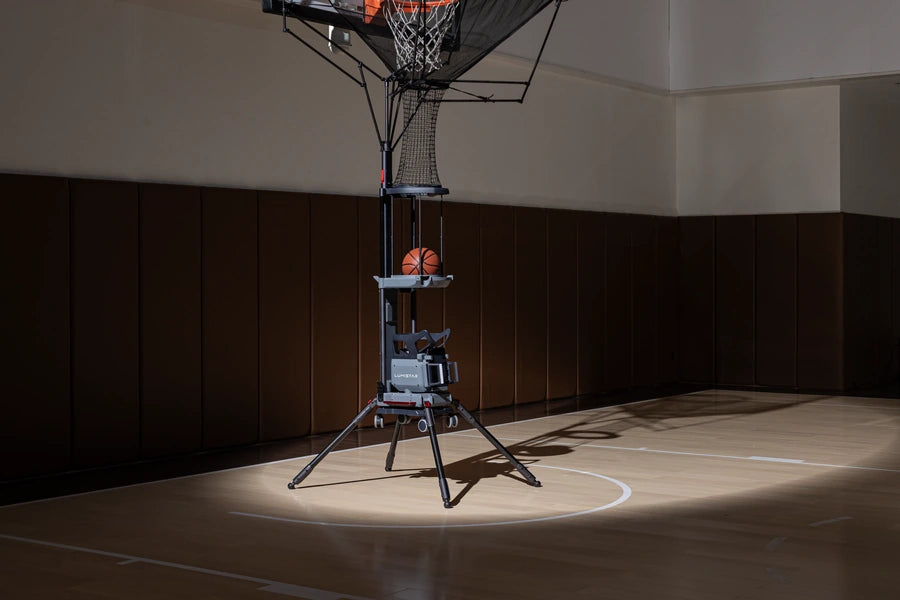
The TERO tennis practice machine supports preset drills, app-customized training patterns, 35 selectable placements, and speeds up to 87 mph. Those capabilities do not mean every setting belongs in a home environment. Select only a placement, pace, height, and interval that the measured lane and backstop can contain.
Use a Low-Risk TERO Test Sequence
Place TERO on a stable, level surface and follow the current setup instructions. Begin with the lowest suitable pace, a single central placement, and a small number of balls. Stand outside the feed path while confirming the first launches. Check the bounce, contact zone, return path, and every escaped ball before adding pace, placement variation, or movement.
App and wristband voice control can reduce unnecessary walks back to the machine for supported changes. They do not replace a physical inspection. Stop the feed before approaching TERO, the backstop, a loose ball, or any object inside the practice lane.

When a Home Setup Should Not Be Used
Do not use a ball machine when the feed lane crosses a road, sidewalk, shared driveway, doorway, or uncontrolled access point. Stop if the surface is slippery, the barrier is unsecured, balls can reach neighboring property, or the player cannot swing and recover without approaching an obstacle.
A garage may appear contained but can introduce a low ceiling, lighting fixtures, shelves, vehicles, hard rebounds, fumes, and doors that are not designed as impact surfaces. If the space only becomes usable by assuming every ball will be hit cleanly, choose a smaller drill, a slower ball, shadow practice, or another location.
A Simple Home Tennis Practice Setup Test
Before a full session, run a short validation in this order:
- Walk the entire feed, player, and return route.
- Close gates and remove people, pets, vehicles, and loose objects.
- Inspect the surface, backstop, side gaps, and anchors.
- Mark one player position and one conservative target.
- Test a few balls at a low setting and watch every bounce and rebound.
- Change only one variable at a time, then test again.
- Stop immediately if a ball leaves the controlled area or the player reaches an obstacle.

Build a Repeatable Home Practice Session
Once the setup passes the test, use short sets with one observable goal. For example, direct ten controlled forehands toward a central target, collect the balls, inspect the containment area, and repeat only if the path remains safe. Consistency matters more than volume in a confined space.
Finish by powering down the machine, collecting every ball, checking the net and anchors, and returning the space to normal household use. A setup that is easy to inspect and reset is more useful than one that depends on a complicated arrangement of temporary objects.
Conclusion
The best tennis practice equipment at home cannot compensate for an unsafe layout. Measure the complete ball path, protect player movement space, direct shots toward a reliable backstop, close side and ground gaps, and test the setup at conservative settings. TERO can support controlled home practice where the measured space is suitable, but full-speed, wide-placement, and full-court drills belong in an environment designed to contain them.
Frequently Asked Questions
Can You Practice Tennis Indoors at Home?
Modified activities such as shadow swings, footwork patterns, and gentle work with slower or foam balls may fit some indoor spaces. Check ceiling height, lighting, glass, furniture, floor traction, and rebound hazards. Do not use normal ball-machine feeds indoors unless the space and current equipment instructions clearly support safe operation.
Should Children Use a Home Ball Machine Setup Alone?
No. A responsible adult should control access, confirm the setup, supervise operation, and follow the current machine instructions. A ball machine and containment net are training equipment, not unsupervised play equipment.
Do Pressureless Balls Make a Home Setup Safer?
Not automatically. Ball construction does not remove the need for safe spacing and containment. Use balls compatible with the machine and drill, keep the batch in reasonably consistent condition, and choose pace and distance that the home area can control.